Recorded Results and Proofs
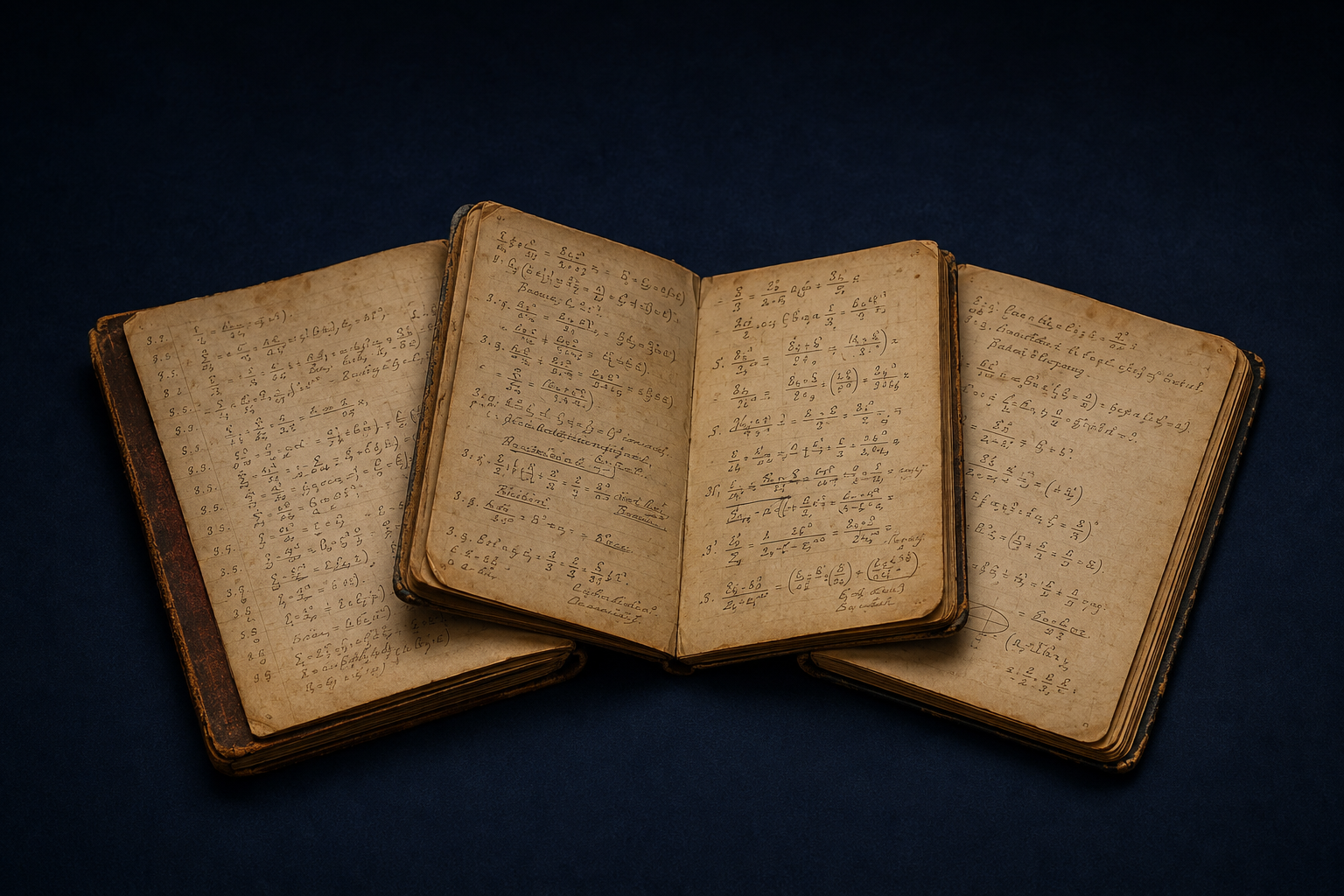
The notebooks preserve results in a compact form. This site distinguishes a recorded result from a proof and does not claim exact notebook attribution unless the supplied source confirms it.
Mathematical Scope
The notebooks range across infinite series, infinite products, continued fractions, modular equations, gamma-function identities, definite integrals, partition identities and asymptotic expansions.
Later Editing and Study
Editors and mathematicians after Ramanujan worked to verify, annotate and place many notebook entries into the language of modern mathematics.
How to Read Them
A notebook entry often functions like a compressed research signal: a formula, identity or transformation appears with little explanation, leaving later readers to reconstruct hypotheses, domains of validity and proofs.
Why They Matter
The notebooks are not only a list of isolated formulas. They show recurring methods, preferred transformations and deep connections among q-series, modular equations, continued fractions and arithmetic functions.
Editorial Caution
This archive treats the notebooks as a guide to Ramanujan's mathematical world while avoiding page-level or manuscript-level claims that are not directly supported by the supplied source material.
Common Subject Clusters
Readers repeatedly encounter families of infinite series, modular equations, continued fractions, special-function identities, asymptotic approximations and arithmetic functions. The categories below organize the archive around those clusters rather than around manuscript page numbers.
From Entry to Understanding
A useful reading habit is to treat each entry as a prompt: identify the notation, look for a related formula, check whether a proof is known from later work, and then compare nearby discoveries in the same category.
Source and Edition Information
Notebook attribution not confirmed in the supplied source. Exact edition-level page references are not asserted here.