Final Period
The material is connected with Ramanujan's last years, including the work he described to Hardy shortly before his death.
Rediscovery
George Andrews found the manuscript material in the 1970s, bringing renewed attention to Ramanujan's final q-series work.
Mathematical Importance
Mock theta functions, partial theta functions, false theta functions, continued fractions and partition identities from this circle of ideas continue to influence research.
A Late Style
The Lost Notebook is especially associated with q-series phenomena whose modular meaning was not fully visible in Ramanujan's own terminology. That gap between notation and later theory is part of its fascination.
From Manuscript to Modern Theory
Modern work connected parts of this material with mock modular forms and harmonic Maass forms. This site marks those connections as later interpretation, not as language Ramanujan himself used.
Research Pathway
A good route through this material is to begin with mock theta functions, then compare partial theta functions, false theta functions and the surrounding q-series identities.
What Makes It Different
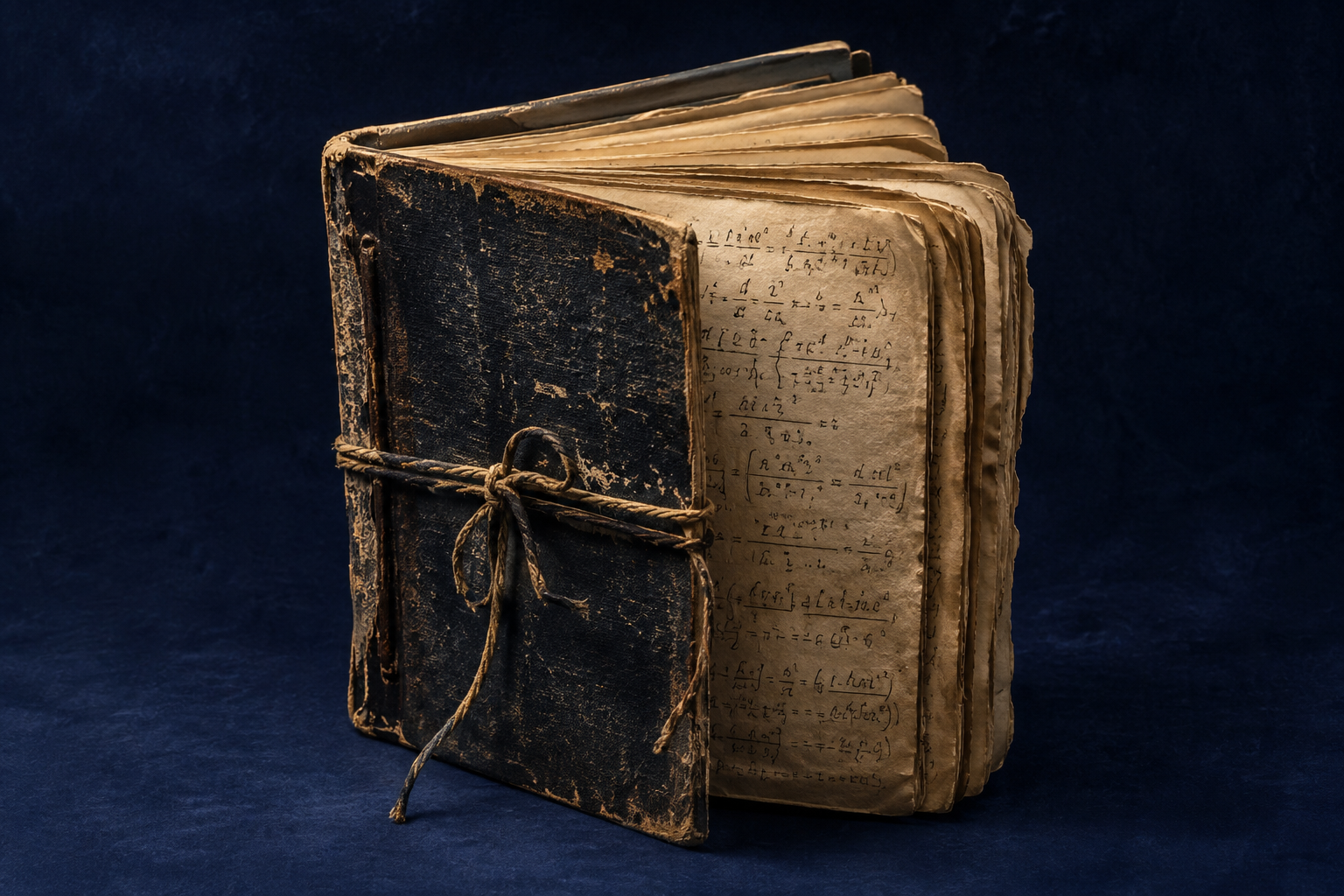
The Lost Notebook feels different from a polished publication because it preserves late-stage mathematical notes: dense formulas, q-series behavior and suggestive identities that later readers had to place into a broader theory.
Mock Theta Functions
The Lost Notebook is inseparable from the modern study of mock theta functions and q-series. This page links those topics without turning them into visualisations.
Partial and False Theta Functions
Related partial and false theta functions appear in the surrounding q-series landscape and remain important to modern interpretation.
Partition Identities
Some surrounding Lost Notebook material belongs to the partition-theoretic world: generating functions, dissections and identities that connect counting problems with q-series structure.
A Reader's Route
Begin with the final letter to Hardy, continue to mock theta functions, then branch into q-series, partial theta functions, false theta functions and harmonic Maass form context.
Modern Research
Later work connected mock theta functions to mock modular forms and harmonic Maass forms, a development after Ramanujan rather than terminology he used.
Editorial Note
This page describes the Lost Notebook as a historical and mathematical cluster. Exact manuscript ordering, transcription and proof status are left to specialist editions and source references.
Source Note
Lost Notebook historical account; exact manuscript-level claims require source verification.